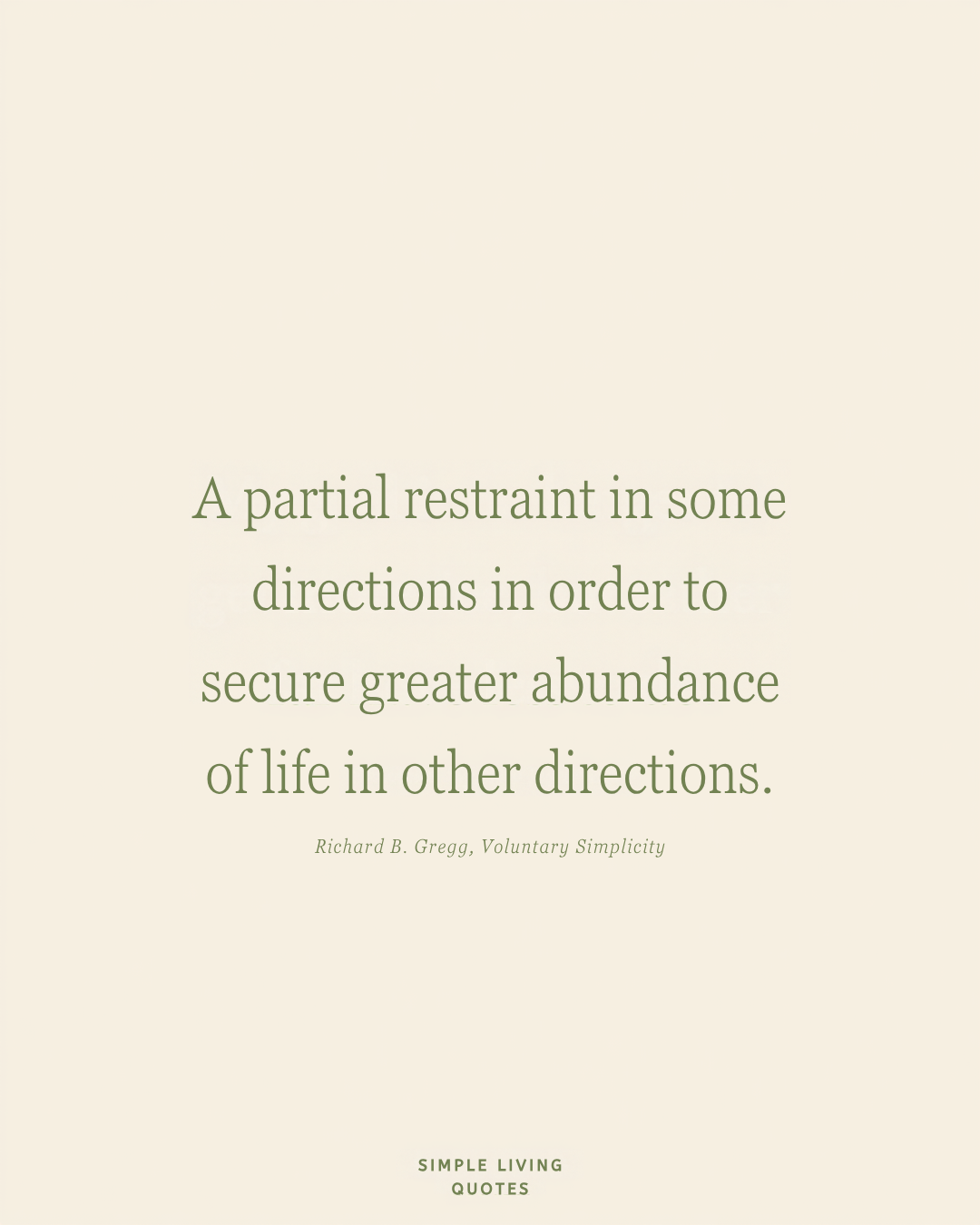
“A partial restraint in some directions in order to secure greater abundance of life in other directions.”
Richard B. Gregg, Voluntary Simplicity
Gregg wrote that line in 1936, long before tiny houses and decluttering challenges had hashtags. He was naming something quieter than a purge. Simplicity, for him, was not a costume of poverty. It was a way to aim your energy.
Restraint sounds like loss until you notice what it frees. You skip one more streaming service, one more weekend of errands that fill the house, one more habit that eats the evening. Suddenly there is room for a walk, a call, a project that actually matters to you. The cut is real. So is the abundance that shows up in its place.
That is the heart of simple living when it is honest. You are not collecting less for the aesthetic. You are choosing a chief purpose and refusing to let clutter (of stuff, of calendar, of noise) dilute it. Gregg called it singleness of purpose on the inside and fewer irrelevant possessions on the outside. The outer change follows the inner one. When the purpose is clear, the extras look less like options and more like distractions with a receipt.
You do not have to shrink every part of life at once. Gregg’s point was selective: hold back where the cost is high and the return is thin, so you can spend yourself where the return is rich. Money, square footage, and hours all work the same way. What you refuse to waste becomes available for what you care about.
One way to live it this week: pick one direction where you will practice a small restraint. Not a life overhaul. One shelf, one subscription, one evening commitment you keep saying yes to out of habit. Remove or pause it for seven days. Then notice what fills the space. If nothing better arrives, you can put the old thing back. If something better does (rest, attention, a clearer kitchen), keep the restraint.
Want a longer set of lines on wanting less and living more? Start with our 25 simple living quotes and pick one for the week.
Leave a Reply